



You’ve probably heard someone say, “He has a fish memory!” That is a common expression used to describe forgetfulness. The idea became even more popular after Pixar’s Finding Nemo, where the character Dory suffers from short-term memory loss. This led to the widespread belief that fish can only remember things for three seconds. But is that scientifically accurate? Can creatures that have survived for millions of years in complex, dangerous ecosystems truly live without a functional memory? Let’s explore modern scientific evidence proving that fish are much smarter and more aware than we once thought — and that the myth of fish weak memory doesn’t reflect the real strength of their memory at all.
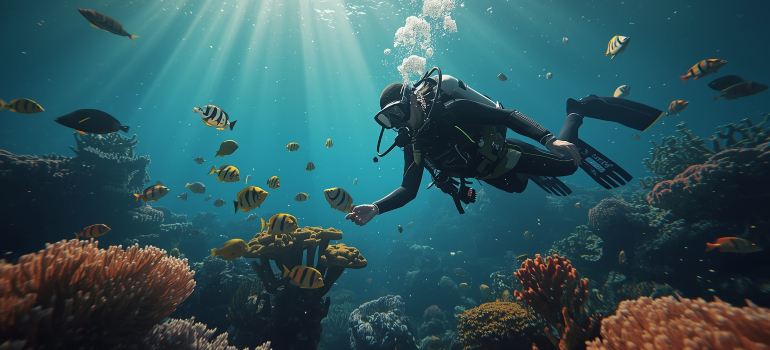
Why do fish have strong memory?
Memory is key to survival. It helps animals find food, avoid danger, and recognize familiar places or other creatures. Fish live in wide, open waters filled with predators. With weak memory, they wouldn’t last a day.
Think about it logically:
How could fish species that have existed for over 500 million years continue to thrive, migrate, and reproduce without a robust memory system?
Scientific experiments reveal fish memory power
Here are several fascinating examples that clearly show fish have a surprisingly strong memory. Scientists have discovered many ways in which fish remember, learn, and adapt — proving they’re much smarter than most people think.
Spatial Memory Experiment
In a well-known study, researchers trained fish to identify where food was placed inside a tank at specific times of the day. Even after a two-week break, the fish gathered at the same place and time expecting food, showing that their memory lasted for weeks — not seconds.

The lever-pressing experiment
Another experiment introduced a lever that released food only at certain times. The fish learned to press it only when feeding time arrived, showing their ability to associate time, action, and reward — a sign of advanced cognitive function.
Fish that learn from mistakes sure hasn’t weak memory
A 2017 study on Guppy fish found that these fish can improve their performance in maze tests through repeated training. After four days, they completed the maze much faster than on day one — evidence of learning through memory similar to mammals.
Complex behavior: tool use and deception
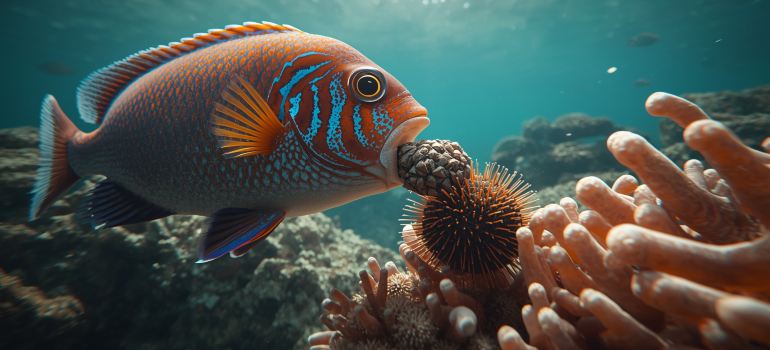
Some fish species have been observed using tools to obtain food. For example, wrasses, especially the orange-dotted Tuskfish, have been observed using rocks as tools. It was dropping rocks on sea urchins to break their shells. Others, like Sailor fish, display protective strategies by attaching their eggs to plant leaves, allowing them to move them quickly if the nest is attacked. These behaviors demonstrate that fish are not mindless creatures but intelligent beings capable of planning and adapting.
Counting and numerical recognition for sure aren’t sign of a weak memory
Researchers showed fish cards with different numbers of dots. In over 1,200 tests, the fish chose the correct card 91% of the time. This shows they can compare numbers and remember patterns — skills once believed to belong only to higher animals.
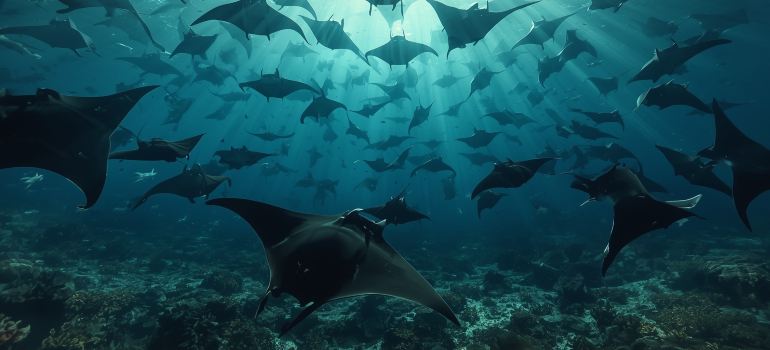
Do manta rays remember their routes?
Manta rays may travel more than 2,000 km across the ocean — and they don’t do it by chance. These gentle giants remember their migration routes, food spots, and cleaning stations year after year. Scientists believe manta rays use both memory and environmental cues to navigate. It’s like they carry an invisible map in their minds, guiding them safely through the vast blue world.
Memory in aquaculture applications
Scientists have applied fish memory to sustainable aquaculture. By training fish to respond to feeding sounds, farmers can later release them into the sea and recall them during harvest using the same sound cue. This clever method proves that fish don’t have a weak memory at all — in fact, they can remember and react after weeks or even months. It also helps reduce feeding costs and supports environmentally friendly farming, all thanks to the strong and reliable memory of fish.
Fish can recognize faces, so no weak memory!
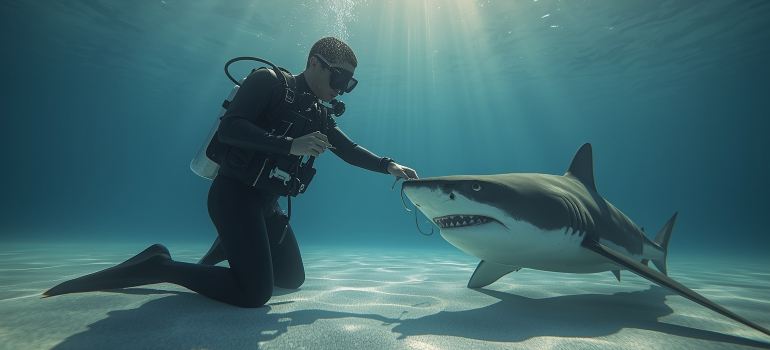
Studies have shown that archerfish can remember and recognize human faces — even after seeing dozens of them. Or, other interesting real-life story with a diver who once removed a fishing hook from a shark’s mouth. After that, the same shark started visiting her regularly — and even brought other sharks that also had hooks stuck in their mouths, as if asking for help. This shows that fish can recognize people, remember positive experiences, and even communicate them to others.
The myth about weak fish memory is entirely false
Scientific research proves that fish can remember things for weeks or even months. They learn from experience and show surprising intelligence. So next time someone says, “He has a fish memory!” — you can confidently correct them. And when you go snorkeling with Hurghada Today, take a closer look. The fish you meet might remember you longer than you think.
References
Oxford University research on Guppy fish behavior (2017).
Spatial memory studies in Animal Cognition journal.
Australian Marine Science Centre studies on fish learning.