



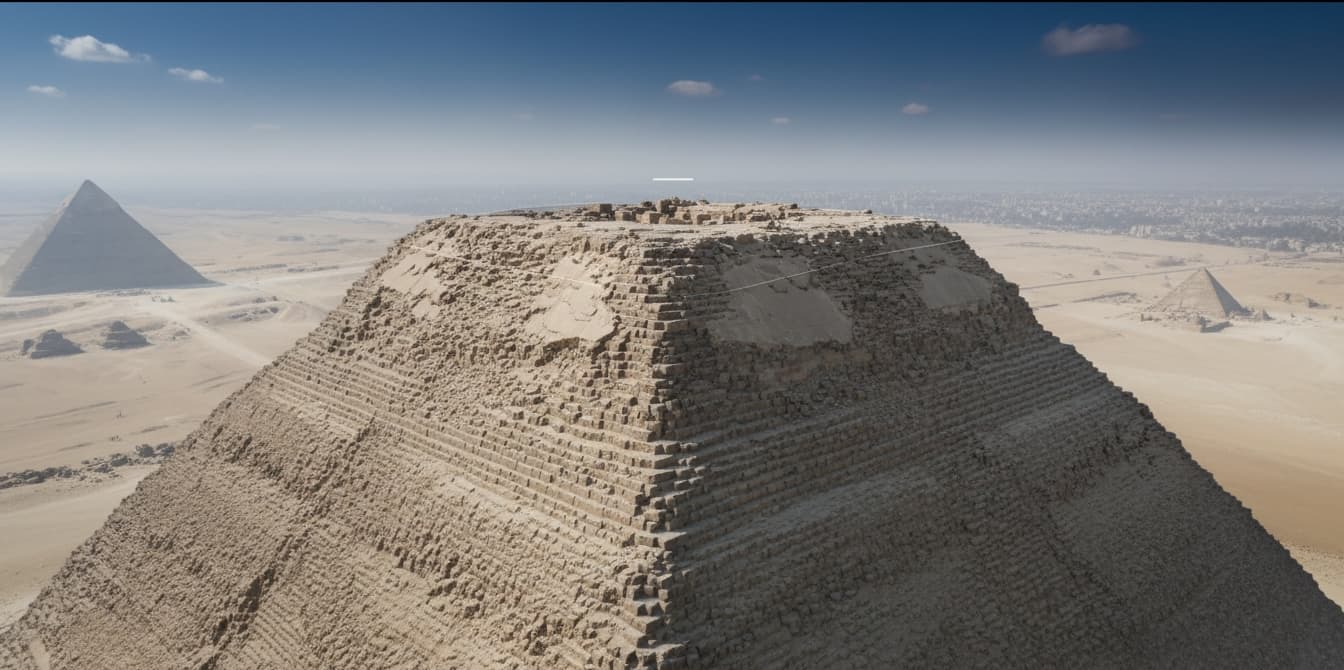
The Great Pyramid of Giza is more than just a tomb. It is an architectural marvel that has defied time for over 4,500 years. Built during the reign of Pharaoh Khufu, it originally stood at an impressive 146.6 meters. However, if you look at its summit today, you will notice something strange: the peak is flat. Today, the pyramid measures approximately 137 meters, meaning about 10 meters of its top, roughly 16 courses of stone, are missing. This raises a fascinating question: What happened to the top of the Great Pyramid?
What history and science tell us
Ancient records suggest that the pyramid has been “headless” for a very long time. Diodorus Siculus, a Greek historian from the 1st century BC, noted even then that the apex was missing. Modern measurements confirm this discrepancy. While environmental erosion is a factor, it is unlikely that wind and sand alone could remove 16 rows of massive limestone blocks, each weighing several tons. When the pyramid was new, it likely had around 217 courses; today, only 201 remain.
The three main theories how the peak vanished
Several compelling arguments attempt to explain the loss of the pyramid’s apex, ranging from natural wear to intentional human activity.
A. Human intervention and “Recycling”
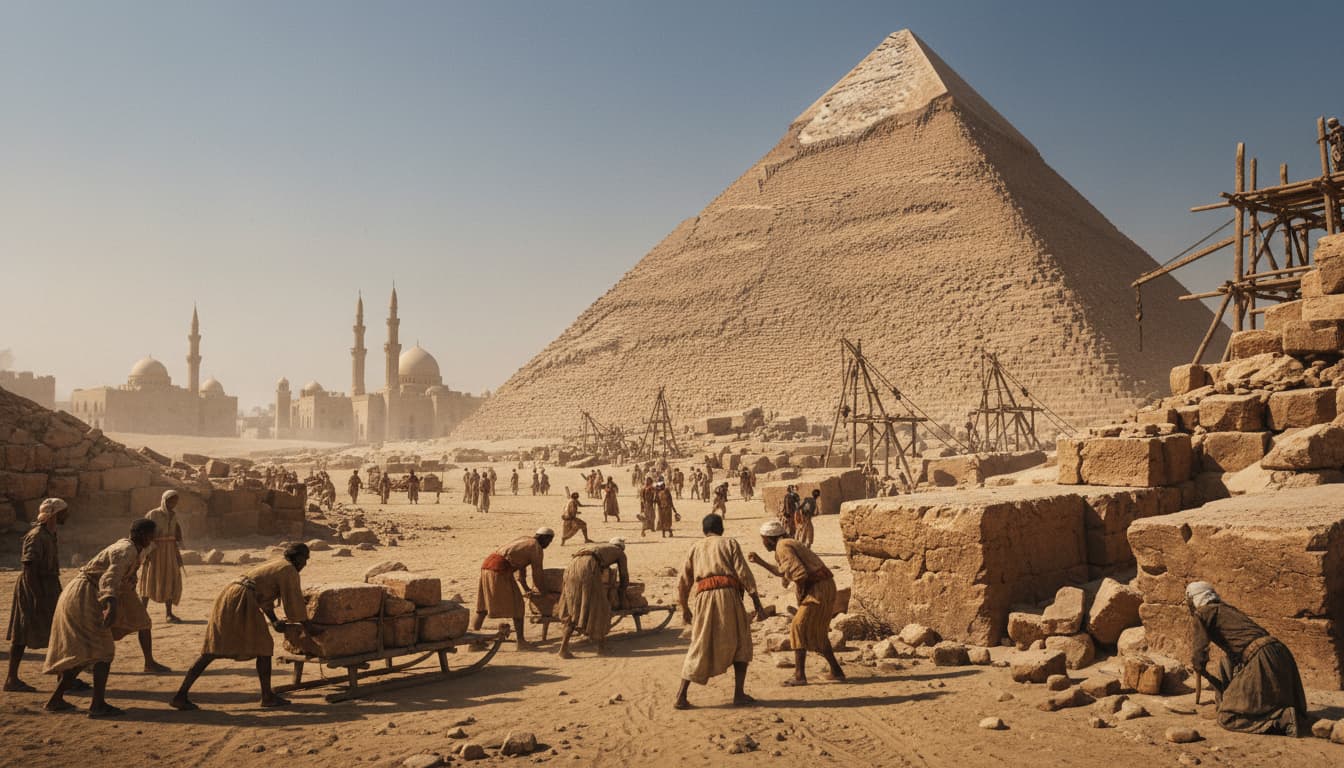
The most plausible theory is that humans, not nature, dismantled the summit. During the 14th century, Cairo underwent a massive building boom. Records show that the pyramid’s outer casing and summit blocks were stripped to build mosques and palaces. In the mid-20th century, the flat top (roughly 10×10 meters) was even used as a gathering spot for adventurous tourists, further altering its shape.
B. The missing “Pyramidion” (capstone)
Every pyramid was meant to be crowned with a pyramidion, a small, pyramid-shaped stone often covered in gold or electrum to reflect the sun. Some Egyptologists believe this capstone was looted or ritually removed in antiquity. Because it was the most valuable part of the structure, it likely became a target for ancient scavengers.
C. Environmental degradation
While wind and sand have rounded the edges of the Giza Plateau, this theory is less likely to explain the missing 10 meters. Nearby pyramids, like the Pyramid of Khafre, still retain parts of their casing and sharper peaks, suggesting that Khufu’s pyramid suffered more from human activity than from the weather.
Modern discoveries: Beyond the surface
The mystery of the pyramid continues to grow. Recent scientific missions, like the ScanPyramids Project, used muon-radiography to find a “big void” at least 30 meters long inside the structure. While this discovery doesn’t solve the mystery of the flat top, it proves that we are still uncovering the secrets of how Khufu’s engineers designed this giant.

Solving the mystery of the top of the Great Pyramid
The flat appearance of the pyramid today isn’t a sign of architectural failure. Instead, it is a “history book” written in stone. It tells a story of ritual removal, medieval quarrying for the city of Cairo, and modern-day tourism. Understanding why the top of the Great Pyramid is flat doesn’t take away from its grandeur; it reminds us that this monument has evolved alongside human history for over four millennia.